How to Measure a Tire Bundle, Woven Bag or Carton for CBM
Your factory says the order is 24 m³. The forwarder's booking says 26. Somebody measured differently, and now nobody's sure whether it fits in a 20GP.
CBM (cubic metres) is simple arithmetic. Getting the measurements right is where it goes wrong, especially with tire bundles that bulge, woven bags that slump, and cartons that aren't quite square. This guide shows where to put the tape, how to do the conversion, and how to run the numbers through our loading plan tool.
All sizes below are examples to show the method. They aren't the packing dimensions of any particular tire size. Measure your own packages.
The formula
For one package:
CBM = Length (cm) × Width (cm) × Height (cm) ÷ 1,000,000
For the shipment:
Total CBM = CBM per package × number of packages
Why 1,000,000? One cubic metre is 100 cm × 100 cm × 100 cm = 1,000,000 cm³. If you measure in metres, skip the division: 0.62 × 0.62 × 0.55 = 0.21142 m³.
If you work in inches, convert first (1 inch = 2.54 cm, exactly), then use the same formula.
What to measure on each package type
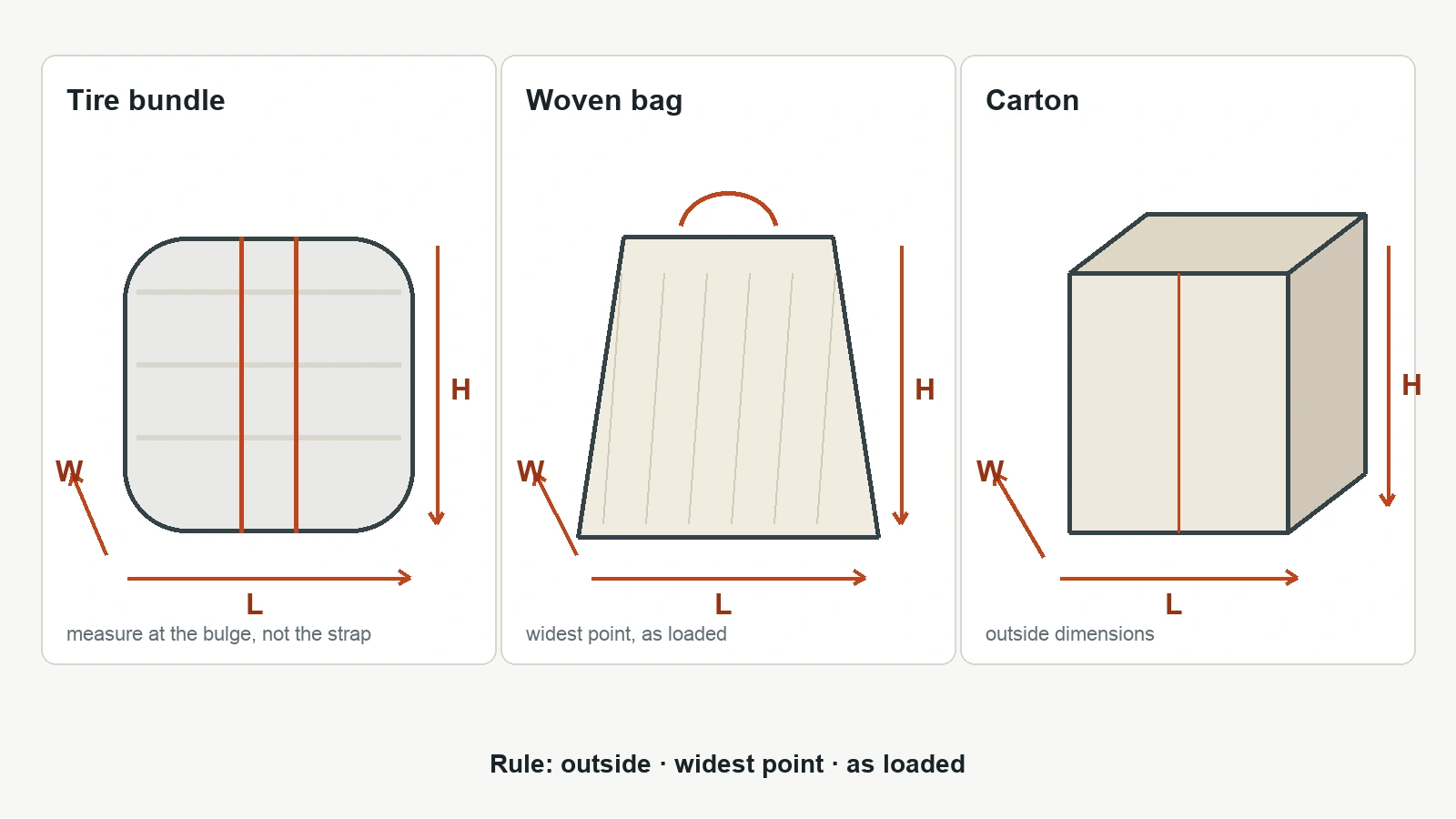
The rule for every package: measure the outside, at the widest point, as it will actually be loaded. A container doesn't care about the average size of a bundle. It cares how much space the bundle blocks.
Tire bundles
A bundle is several tires strapped or wrapped together. (If you're not sure which bundle style your factory uses, see motorcycle tire bundle packaging types.)
- Length and width: measure across the tires, edge to edge, at the widest point. If the bundle isn't perfectly round or square, take the larger of two measurements across.
- Height: stand the bundle the way it will sit in the container and measure from the floor to the highest point, including any bulge at the top.
- Bulges: compressed tires push out in the middle. Measure at the bulge, not at the strap.
- Wrapping: measure over the wrapping film or bag, not the bare rubber.
Loose stacks
For tires loaded loose in a stack, measure one stack as it stands: footprint across the widest tire, height from the floor to the top tire. Then count how many stacks the shipment needs.
Woven bags
Inner tubes are often packed in woven bags, which don't hold a fixed shape.
- Fill and close the bag exactly as you will for shipping.
- Lay or stand it the way it will be loaded, let it settle, then measure length, width and height at the widest points.
- Measure two or three bags and use the largest set of numbers. Bags vary more than cartons.
Cartons
Cartons are the easy one. Measure the outside of the closed carton, including any lid overhang, strapping or corner protection. Don't use the inside dimensions printed on the box spec.
A worked example
Here's how the arithmetic looks with example numbers.
Outer tires (example): bundles measuring 62 × 62 × 55 cm, 100 bundles.
- One bundle: 62 × 62 × 55 = 211,420 cm³ = 0.21142 m³
- 100 bundles: 0.21142 × 100 = 21.142 m³
Inner tubes (example): cartons measuring 50 × 40 × 30 cm, 80 cartons.
- One carton: 50 × 40 × 30 = 60,000 cm³ = 0.06 m³
- 80 cartons: 0.06 × 80 = 4.8 m³
Cargo volume: 21.142 + 4.8 = 25.942 m³
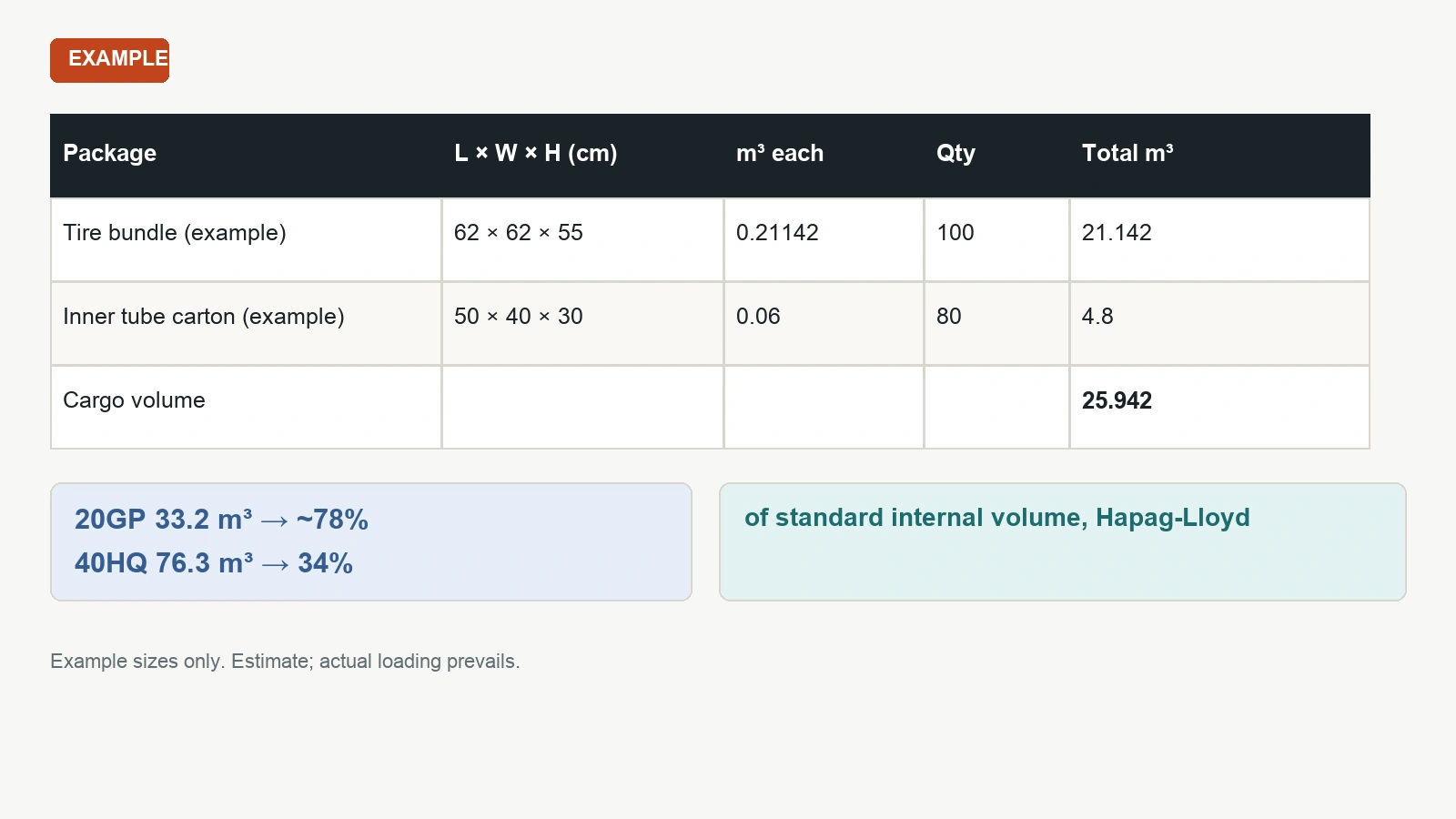
Compared with standard internal volumes from Hapag-Lloyd's published specifications, as listed on our reference page:
- 20GP, 33.2 m³: 25.942 ÷ 33.2 = about 78% of standard internal volume
- 40HQ, 76.3 m³: 25.942 ÷ 76.3 = 34% of standard internal volume
Those percentages compare against the standard internal volume, not usable capacity. Packages don't tessellate perfectly, and stacking and stuffing methods decide how much really goes in. For a deeper comparison of the two container sizes, see 20GP vs 40HQ for motorcycle tires.
Running it through the loading plan tool
Our Container Loading Plan does the same calculation in three steps:
- Outer Tire. Choose Bundle or Loose stack, enter the measured length, width and height in cm, the number of packages, and the pieces per package. The tool uses your dimensions as entered. It "applies no tire-size formula and no gap coefficient", so the result is only as good as your tape measure.
- Inner Tube. Choose Woven bag or Carton and enter the same fields. If the shipment has no tubes, set the package count to 0.
- Container Result. You'll see outer tire volume, inner tube volume and total cargo volume, plus the share of 20GP and 40HQ standard internal volume.
There's an optional field, Reserved container space (m³). Anything you enter there is added on top of the cargo volume as extra occupied space (for example, room you want to keep for dunnage or a later add-on); the cargo volume itself doesn't change. It defaults to 0.
In the example above, reserving 2 m³ would bring occupied volume to 27.942 m³, about 84% of a 20GP's standard internal volume.
If you only need the inner tubes, the inner tube calculator handles woven bags and cartons on their own.
Why your CBM doesn't match the forwarder's
When two people get different numbers for the same cargo, it's almost always one of these.
Small measuring differences add up
Measure the example bundle 1 cm larger on every side, 63 × 63 × 56 cm instead of 62 × 62 × 55 cm, and the volume per bundle goes from 0.21142 m³ to 0.22226 m³, about 5% more. Over 100 bundles, that's an extra 1.08 m³ from one centimetre.
Different measuring points
One person measures at the strap, another at the bulge. One measures a carton's inside, another the outside. Agree on "outside, widest point, as loaded" before anyone picks up a tape.
Rounding at the wrong stage
Rounding each package to 0.2 m³ before multiplying, instead of at the end, can shift the total noticeably on a large order. Keep full precision until the final figure.
Chargeable volume vs measured volume
A forwarder's quote may use its own rounding, minimums or weight-to-volume rules for LCL. Those are commercial terms, not measurement errors; ask how they calculate the figure on the quote.
Whatever the numbers say, the actual loading decides. Treat any CBM figure, including ours, as an estimate to plan with, and confirm with your factory's loading record.
FAQ
What is the CBM formula in centimetres?
Length × width × height in cm, divided by 1,000,000, gives cubic metres for one package. Multiply by the number of packages for the shipment.
Should I measure a tire bundle at the strap or the bulge?
At the bulge. The widest point is what takes up space in the container.
How do I measure CBM for a woven bag?
Pack and close the bag as it will ship, let it settle in its loading position, and measure length, width and height at the widest points. Measure a few bags and use the largest figures.
Does 25 m³ of cargo fit in a 20GP?
A 20GP has a standard internal volume of 33.2 m³ (Hapag-Lloyd), but that isn't usable capacity. Whether a given load fits depends on package shape, stacking and stuffing method. Treat the percentage as a guide and confirm with the actual loading.
Can I enter inches in the loading plan tool?
The tool takes centimetres. Convert inches by multiplying by 2.54 before entering.
Sources
| Source | URL | Checked |
|---|---|---|
| tirecbm.com Reference Data(container internal volumes, citing Hapag-Lloyd specifications) | https://tirecbm.com/reference/ | 20261026 |
| tirecbm.com Container Loading Plan(tool field descriptions) | https://tirecbm.com/loading-plan/ | 20261026 |