轮胎装柜基础:CTU Code 怎么说
装柜计算器能告诉你,这批轮胎捆装不装得下一个柜子;它不会告诉你怎么堆、重量该落在哪、海上摇晃时靠什么不让货移位。这几件事决定货到港时是不是原样,也决定柜子吊装、拖运、开门时安不安全。
这方面国际上通用的参考是 CTU Code,全称《IMO/ILO/UNECE 货物运输单元装载操作规范》(Code of Practice for Packing of Cargo Transport Units)。本文挑出装轮胎时最要紧的几条,附上条款号,方便你对照原文。
CTU Code 是什么
CTU Code 由国际海事组织(IMO)、国际劳工组织(ILO)和联合国欧洲经济委员会(UNECE)共同制定,2014 年由 IMO 以通函 MSC.1/Circ.1497 发布。「货物运输单元」包括集装箱、公路车辆和铁路货车等。
IMO 官网把它描述为「a non-mandatory global code of practice」(一部非强制性的全球操作规范)。它不取代各国法规,也不取代船公司的要求;它的要点写成一条条「要做 / 不要做」,可以直接当检查单用。
CTU Code 没有专门讲轮胎的条款。下面都是通用要求,对轮胎和对别的货一样适用;我们把哪一条对到轮胎装柜上,都会写明是我们的理解。
谁负责什么
CTU Code 把装货的人或公司叫做 packer(装箱人)。第 4.2.3 条列了装箱人的责任,其中包括:
- 装货前检查柜子,确认柜况适合这批货;
- 装货时不让箱底受力过度;
- 确保「the cargo is correctly distributed in the CTU and properly supported where necessary」(货物在箱内分布正确,需要时有适当支撑);
- 不超载;
- 货物固定充分;
- 关门、加封,并把封条信息报给托运人(shipper);
- 准确确定装好后整箱的总重(gross mass)并转交出去。
如果是工厂或货代仓库在装柜,这几点就是你可以向他们确认的。
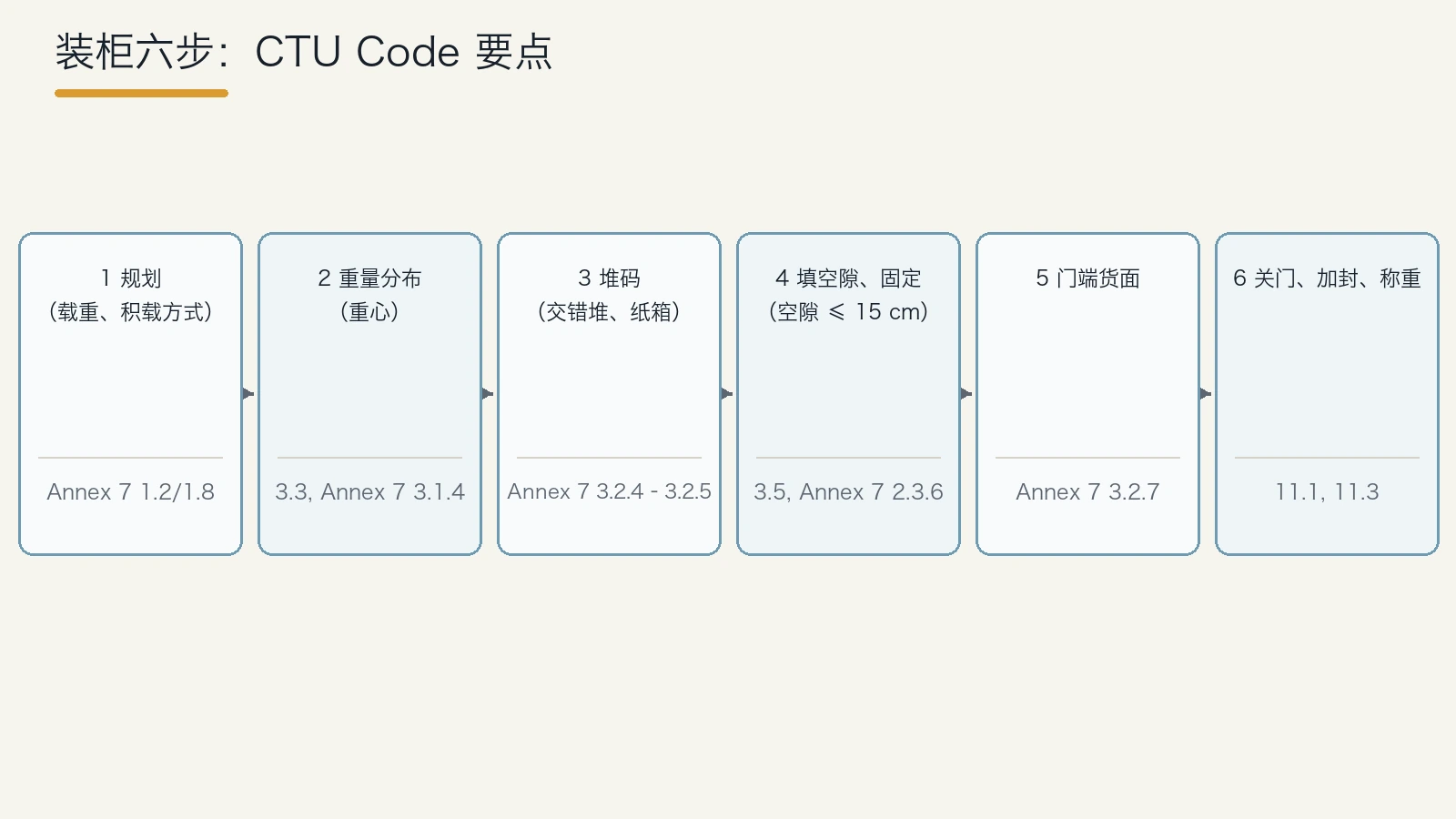
第一步:装之前先规划
附件 7(Annex 7)第 1 节讲规划。对轮胎货最要紧的是三点。
选「塞满」还是「固定」。 原文说规划应当做成两种之一:「a tight stow, where all cargo packages are placed tightly within the boundaries of the side and front walls」(紧密积载:货物紧贴侧壁和前壁装满),或「a secured stow, where packages do not fill the entire space and will therefore be secured within the boundaries of the CTU by blocking and/or lashing」(固定积载:货没装满整个空间,要用挡块和/或绑扎固定)(附件 7,1.2)。轮胎捆能从一侧壁贴到另一侧壁装满,就是紧密积载;装不满,就得固定。
不只看体积,还要看重量上限。 「The mass of the planned cargo should not exceed the maximum payload of the CTU」(计划装的货重不应超过箱子的最大载重)(附件 7,1.8)。集装箱允许的最大总重标在 CSC 安全铭牌上。规范还提醒,沿途道路、起吊设备等的限制「may be considerably lower than the permitted gross mass」(可能比允许总重低得多)(1.9)。
看包装标记和堆码强度。 标了「this way up」(此面向上)的要照做,标了最大堆码高度的「should not be exceeded」(不应超过)(1.5)。堆起来的包装,每一件都应「capable of supporting those placed above them」(撑得住压在上面的货)(1.6)。纸箱装的内胎如果要放在较重的轮胎捆下面,这一条值得核一下。
我们的装柜计划工具算的是你的轮胎捆或纸箱占多少体积、占柜子多少比例。空间问题用工具算,重量和积载问题看本文这几条。
第二步:重量分布要对
第 3 章「关键要求」里有这几条:
- 「Do distribute heavy cargo appropriately over the floor area.」(重货要在箱底合理分布。)
- 「Do load with the centre of gravity correctly located in the CTU.」(装货时重心要落在正确位置。)
- 「Do not load with eccentric load distribution.」(不要偏载。)
- 「Do not stow heavy goods on top of light goods.」(不要把重货压在轻货上面。)
(CTU Code,3.3)
重心应该在哪
附件 7 第 1.11 条分三个方向讲:
- 纵向(长度方向): 在允许范围内;
- 横向(宽度方向): 靠近箱宽的一半处;
- 垂向(高度方向): 低于货舱高度的一半。
对水平吊装的集装箱,附件 7 第 3.1.4 条补充:货物重心应接近箱子长度和宽度的中点。「The eccentricity of the centre of gravity of the cargo should not exceed 5% in general. As a rule of thumb this can be taken as 60% of the cargo's total mass in 50% of the freight container's length.」(货物重心的偏心一般不应超过 5%;经验做法是:箱子任意一半长度内的货重不超过总货重的 60%。)规范说特殊情况下可以接受最多 10%(could be accepted),因为有的吊具能调整偏心。
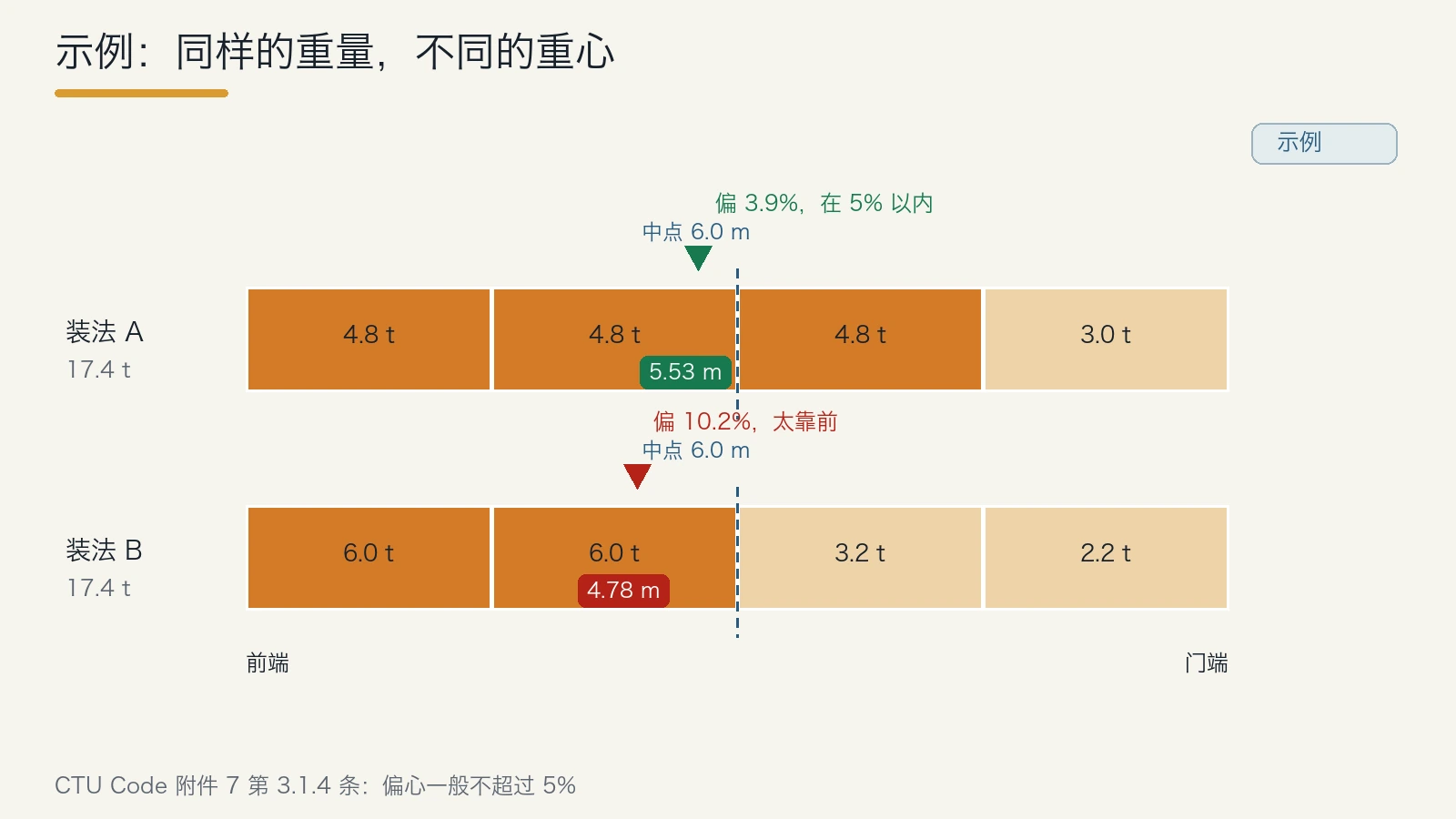
算一算:示例
规范附件 7 附录 4 第 3 节给了纵向重心的公式:每部分货重乘以它的重心到箱子前端的距离,加起来,再除以总货重。
d = Σ(货重 × 距离)÷ Σ 货重
以下仅为示例。 假设货区长 12.0 m,分 4 段、每段 3 m,段中心离前端分别是 1.5、4.5、7.5、10.5 m。
| 第 1 段 | 第 2 段 | 第 3 段 | 第 4 段 | 合计 | |
|---|---|---|---|---|---|
| 装法 A:货重(吨) | 4.8 | 4.8 | 4.8 | 3.0 | 17.4 |
| 装法 B:货重(吨) | 6.0 | 6.0 | 3.2 | 2.2 | 17.4 |
- 装法 A:(4.8×1.5 + 4.8×4.5 + 4.8×7.5 + 3.0×10.5)÷ 17.4 = 96.3 ÷ 17.4 = 离前端 5.53 m。中点是 6.0 m,偏了 0.47 m,占货区长度的 3.9%;前半段承重占 55.2%。在 5% 的一般限值和「60/50」经验做法以内。
- 装法 B: 总重一样,但重的轮胎捆都放在前半段。83.1 ÷ 17.4 = 4.78 m,偏离中点 1.22 m,即 10.2%;前半段承重占 69%。超过 5% 的一般限值,也超过规范只在特殊情况下才接受的 10%。
装法 B 就是「先装最重的规格、剩下空间塞轻纸箱」时容易出现的情况。
第三步:堆得稳,货形不散
CTU Code 按包装类型讲堆码。编织袋包的轮胎捆,规范里没有点名;最接近的描述是「packages with a less defined shape like bags or bales」(袋装、捆装这类外形不规则的包装),可以「stacked in an interlocking pattern, also called cross-tie, thereby creating a solid pile that may be secured by blocking or fencing」(交错堆码,堆成一个整体,再用挡块或围栏固定)(附件 7,3.2.5)。把轮胎捆对到这一条,是我们的理解,不是规范对轮胎的原话。
纸箱(比如内胎)的堆码,规范要求「should be precise in a way that the mass from above is transferred to the vertical boards of the cartons below」(堆齐,让上面的重量落在下面纸箱的竖板上),需要时层间加纤维板、胶合板或托盘(3.2.4)。
关键要求里的通用规则也适用:尽量避免「irregular layers of packages」(参差不齐的货层),不要把重货压在轻货上(3.3)。常见的捆包规格见我们的轮胎捆包方式说明。
第四步:填空隙、做固定
空隙会让货移位。关键要求里关于固定(3.5)有这几条:
- 「Do fill void spaces when necessary.」(必要时填满空隙。)
- 「Do use blocking or lashing or a combination of these methods to prevent the cargo from sliding and tipping in any direction.」(用挡块、绑扎或两者结合,防止货物向任何方向滑动和倾倒。)
- 「Do not secure the cargo with devices overstressing the structure of the CTU or the cargo.」(固定装置不能让箱体或货物受力过度。)
附件 7 第 2.3.6 条把紧密积载里的空隙讲得很具体:空隙「should be filled」(应当填满),可以竖着塞空托盘,再用木条撑紧;「which may deform or shrink permanently, like rags of gunny cloth or solid foam of limited strength, should not be used for this purpose」(会永久变形或收缩的材料,比如麻布碎料、强度不够的泡沫,不应用来填空隙)。装卸必需的小缝隙可以不填,但「the sum of void spaces in any horizontal direction should not exceed 15 cm」(任一水平方向上的空隙合计不应超过 15 厘米)。
挡块和绑扎的具体方法和计算,在附件 7 第 4 节及其附录里。
第五步:门端做出平整的货面
最后一排关系到开门的人。规范说,快装完时「care should be taken to build a firm face of the cargo so as to prevent a "fall out" when the CTU is opened」(要做出稳固的货面,防止开门时货掉出来)(附件 7,3.2.7)。如果拿不准货面稳不稳,可以把顶层货绑回系固点,或在后角柱之间搭木围栏。
原因规范也写了:「a freight container on a trailer usually inclines towards the doors aft and that cargo may move against the doors due to vibration induced shift or by jolts during transport」(集装箱放在拖车上通常向门端倾斜,运输中的振动和颠簸会让货往门上挤)。规划时也要考虑拆箱的人,「the possibility of cargo falling out when the CTU is opened should definitely be avoided」(必须避免开门时掉货)(1.7)。
第六步:关门、加封、确定总重
第 11 章讲最后一捆装进去之后的事:
- 关好门。 装箱人「should ensure that all closures are properly engaged and secured」(确认所有关闭装置都扣好、锁好)(11.1.1)。
- 加封。 需要时,国际运输的集装箱应在装完后「be sealed immediately upon completion of the packing with a seal bearing a unique identification number」(立即加上带唯一编号的封条),「countries may require that such seals meet the standard of ISO 17712」(有的国家要求封条符合 ISO 17712)(11.1.2)。
- 确定总重。 「The packer is responsible for accurately determining the gross mass of the packed CTU」(装箱人负责准确确定装好后整箱的总重)(11.3.2),并把箱号、核实后的总重和封号告诉托运人,好写进提单等单据(11.3.3)。
这些编号最后都会出现在单据上,提单的几种形式见正本提单、电放和海运单;柜子尺寸见集装箱内尺寸和门口尺寸。
常见问题
CTU Code 是什么?
《IMO/ILO/UNECE 货物运输单元装载操作规范》,2014 年由 IMO 以 MSC.1/Circ.1497 发布,讲怎样安全地装集装箱和其他货物运输单元。IMO 说明它是非强制性的。
集装箱里的重量应该怎么分布?
重货在箱底铺开,重心靠近长度和宽度的中点、低于货舱高度的一半。规范说偏心一般不超过 5%;经验做法是任意一半箱长内的货重不超过总货重的 60%。
CTU Code 有没有讲轮胎怎么堆?
没有,规范里没有专门讲轮胎的条款。它关于堆码、重量分布、填空隙和固定的通用要求,对轮胎和对别的货一样适用。
出处
| 出处 | 网址 | 查询日期 |
|---|---|---|
| IMO,MSC.1/Circ.1497,IMO/ILO/UNECE Code of Practice for Packing of Cargo Transport Units (CTU Code),2014-12-16(第 3、4、11 章;附件 7) | https://wwwcdn.imo.org/localresources/en/OurWork/Safety/Documents/1497.pdf | 20261102 |
| IMO,CTU Code 介绍页(「non-mandatory」) | https://www.imo.org/en/ourwork/safety/pages/ctu-code.aspx | 20261102 |
| 重心示例:用 CTU Code 公式自行计算(Python,2026-11-02) | — | 20261102 |