Container Internal Dimensions vs Door Openings: 20GP, 40GP and 40HQ
Most people plan a shipment with one number in mind: the container's internal volume. A 20GP is about 33 m³, a 40HQ about 76 m³, so if your cargo comes to 30 m³ it should fit in a 20GP.
Then the loading day comes and things go wrong. A pallet that fits under the roof won't go through the door. A stack of tire bundles leaves a gap at the top that nothing fills. The volume figure was right, but it was never the whole story.
This guide puts three sets of numbers side by side, using carriers' published specifications: inside dimensions, door openings and internal volume. Then it explains why "usable" space is always less than the headline volume.
The numbers from the carriers
Container dimensions vary a little between carriers and container builds, so we list each carrier's figures separately rather than averaging them. Always confirm with the carrier you're booking with.
Ocean Network Express (ONE)
ONE's Container Information page lists these dry containers (checked 28 October 2026):
| 20' Dry | 40' Dry | 40' High Cube | |
|---|---|---|---|
| Inside length | 5,898 mm | 12,032 mm | 12,032 mm |
| Inside width | 2,350 mm | 2,350 mm | 2,350 mm |
| Inside height | 2,390 mm | 2,390 mm | 2,695 mm |
| Door opening width | 2,340 mm | 2,340 mm | 2,340 mm |
| Door opening height | 2,280 mm | 2,280 mm | 2,585 mm |
| Load capacity | 33.1 m³ | 67.6 m³ | 76.2 m³ |
ONE adds a caution worth repeating: "Please note this is for reference only. Individual containers may have different specifications from the measurement shown above."
Hapag-Lloyd
Our reference data page lists Hapag-Lloyd's published figures for the two containers our calculators use:
| 20GP | 40HQ | |
|---|---|---|
| Inside dimensions | 5,900 × 2,352 × 2,395 mm | 12.03 × 2.35 × 2.70 m |
| Standard internal volume | 33.2 m³ | 76.3 m³ |
| Door opening | not on our reference page | not on our reference page |
The two carriers' figures differ by a few millimetres and 0.1 m³. That's normal, and it's why we don't average them.
Door opening vs inside height: the gap that catches people
Look at the ONE figures again:
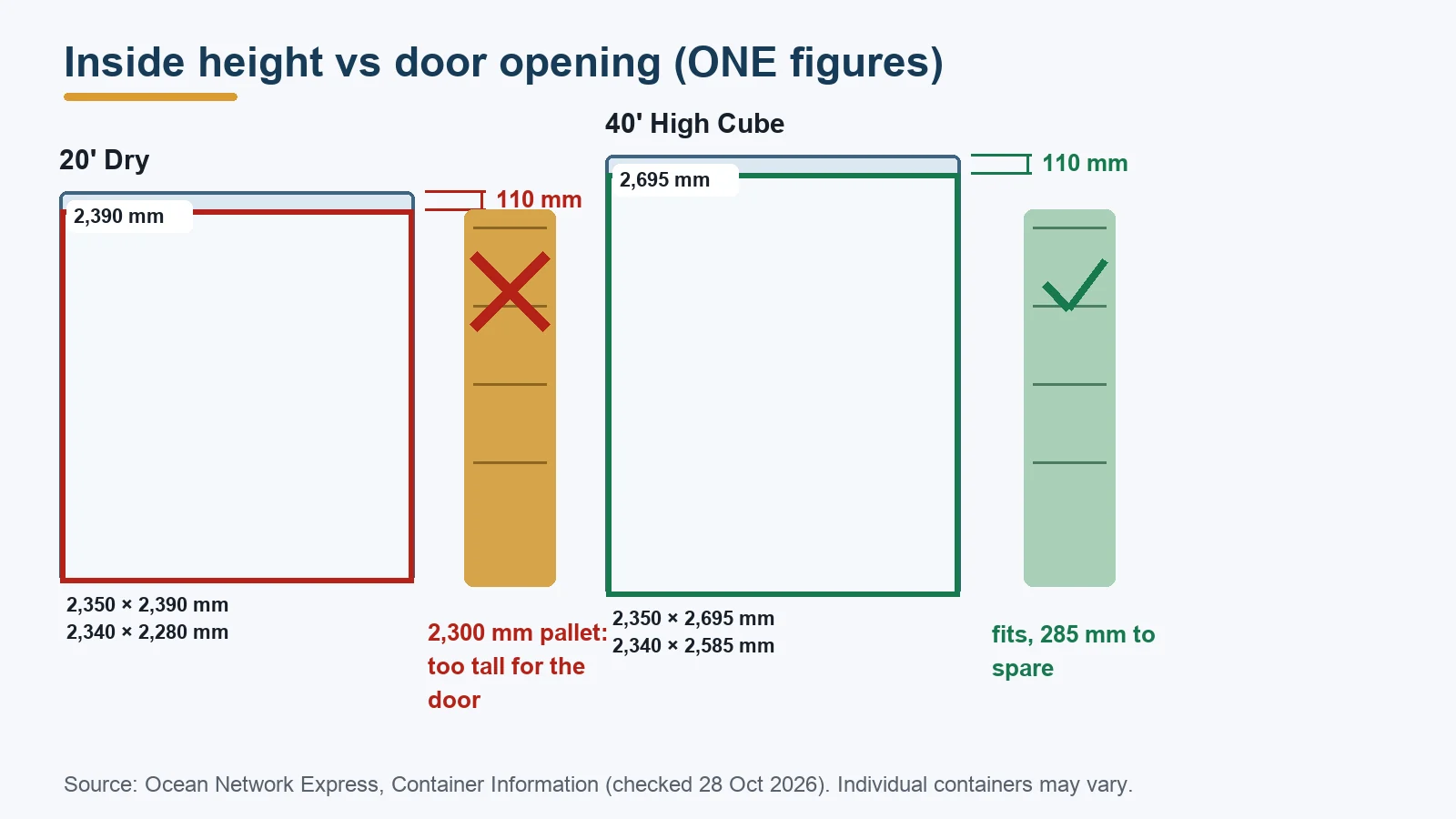
- 20' Dry: inside height 2,390 mm, door height 2,280 mm, so the door is 110 mm lower than the inside.
- 40' High Cube: inside height 2,695 mm, door height 2,585 mm, also 110 mm lower.
- Width: inside 2,350 mm, door 2,340 mm, so the door is 10 mm narrower.
The carriers' tables don't explain the difference, but the practical effect is clear. Anything that goes in as one piece (a pallet, a crate, a pre-wrapped stack) has to pass under that header. So for loading through the door, the height limit is the door height, not the inside height.
A worked example: pallets
Say you've palletized cargo and the loaded pallet is 2,300 mm tall. Against ONE's figures:
- 20' Dry: 2,300 mm is under the 2,390 mm inside height, but over the 2,280 mm door height. It won't go through the door.
- 40' High Cube: 2,300 mm is under the 2,585 mm door height. It fits through, with 285 mm to spare.
If you only compared the pallet with the inside height, the 20' would look fine on paper.
What about cargo stacked by hand?
Loose cartons, bags and tire bundles are usually carried in and stacked piece by piece. Each piece only has to clear the door on its own, so the stack inside can go higher than the door. But the crew still needs room to lift the top layer into place, so you won't reach the roof exactly. How much room depends on the cargo and the people loading it, which is why there's no fixed figure for it.
Why internal volume isn't usable volume
The internal volume is just length × width × height of the empty box. ONE's 20' figure checks out: 5.898 × 2.350 × 2.390 = 33.1 m³. That's the space available, not the space you'll fill.
Your cargo comes in fixed sizes, and fixed sizes rarely divide the box exactly. Here's a simple height example using the example tire bundle from our CBM measuring guide, which is 55 cm tall (an example size, not a standard):
| Container (ONE figures) | Inside height | Layers of 55 cm bundles | Stack height | Left at the top |
|---|---|---|---|---|
| 20' Dry | 2,390 mm | 4 | 2,200 mm | 190 mm |
| 40' High Cube | 2,695 mm | 4 | 2,200 mm | 495 mm |
A fifth layer would be 2,750 mm, too tall for either. In the 40' High Cube that leaves almost half a metre empty at the top, unless you fill it with shorter packages such as cartons of inner tubes.
The same thing happens along the length and width. Bundles 62 cm across fit three wide in 2,350 mm (1,860 mm), leaving 490 mm, which isn't enough for a fourth. Every one of those leftover strips is volume you've paid for and can't use with that package size.
That's why we always say a percentage of internal volume is a planning figure, not a guarantee. In practice, the usable share depends on:
- package sizes and how they divide into the box
- stacking: whether packages can be turned or laid differently
- mixing: whether smaller items can fill the gaps
- loading clearance at the top and by the doors
- weight: heavy cargo can reach the payload limit before the box is full
How to plan with all three numbers
- Check single pieces against the door. Any pallet, crate or wrapped stack must be lower than the door height (2,280 mm or 2,585 mm in ONE's figures) and narrower than the door width.
- Plan layers against the inside height. Work out how many layers fit, then subtract a little for loading clearance.
- Use volume for a first estimate only. Our loading plan tool compares your measured cargo volume with 20GP and 40HQ standard volumes. Treat the result as a starting point.
- Confirm with your carrier and your loading team. Containers vary, and the actual stuffing is what counts.
If you're still choosing between container types, our 20GP vs 40HQ comparison covers that decision.
FAQ
What is the door opening of a 20ft container?
ONE lists its 20' Dry door opening as 2,340 mm wide and 2,280 mm high. Other carriers' containers can differ slightly, so check your carrier's own specification.
How tall is the door of a 40ft high cube?
ONE lists 2,585 mm for its 40' High Cube, against an inside height of 2,695 mm.
What are the inside dimensions of a 40HQ?
ONE lists 12,032 × 2,350 × 2,695 mm (76.2 m³). Hapag-Lloyd's figures on our reference page are 12.03 × 2.35 × 2.70 m (76.3 m³).
Is the internal volume how much I can load?
No. It's the empty box. Package sizes, stacking, loading clearance and weight all reduce what you can actually load.
Is a 40' standard container the same height as a 20'?
In ONE's figures, yes: both are 2,390 mm high inside with a 2,280 mm door. The 40' High Cube is the taller one.
Sources
| Source | URL | Checked |
|---|---|---|
| Ocean Network Express (ONE), Container Information | https://www.one-line.com/en/container-information | 20261028 |
| tirecbm.com reference data (Hapag-Lloyd 20GP and 40HQ figures, linking Hapag-Lloyd's specification pages) | https://tirecbm.com/reference/ | 20261028 |