Bill of Lading Basics for Exporters: Original, Telex Release and Sea Waybill
Your buyer emails: "Please do telex release." Or the booking form asks whether you want an original bill of lading or a sea waybill. If you're not sure what the difference is, you're not alone. The three options decide one important thing: who can collect the goods at the destination, and what they need to show to do it.
This guide explains each option using the carriers' own published terms. It doesn't tell you which one to choose. That depends on your contract with your buyer, how you're being paid, and your bank. Talk to your freight forwarder and your bank before you decide.
Why the bill of lading matters
The bill of lading (B/L) is the document the carrier issues for your shipment. Depending on how it's issued, it can do more than record what was loaded. It can control who receives the goods.
You'll see this in the carriers' terms. Evergreen's bill of lading clauses, for example, say the goods are to be "delivered unto order or assigns" and that "If issued in paper form and if required by the Carrier, this Bill duly endorsed must be surrendered in exchange for the Goods or Delivery Order." In other words, whoever properly holds the original can claim the cargo.
1. Original bill of lading
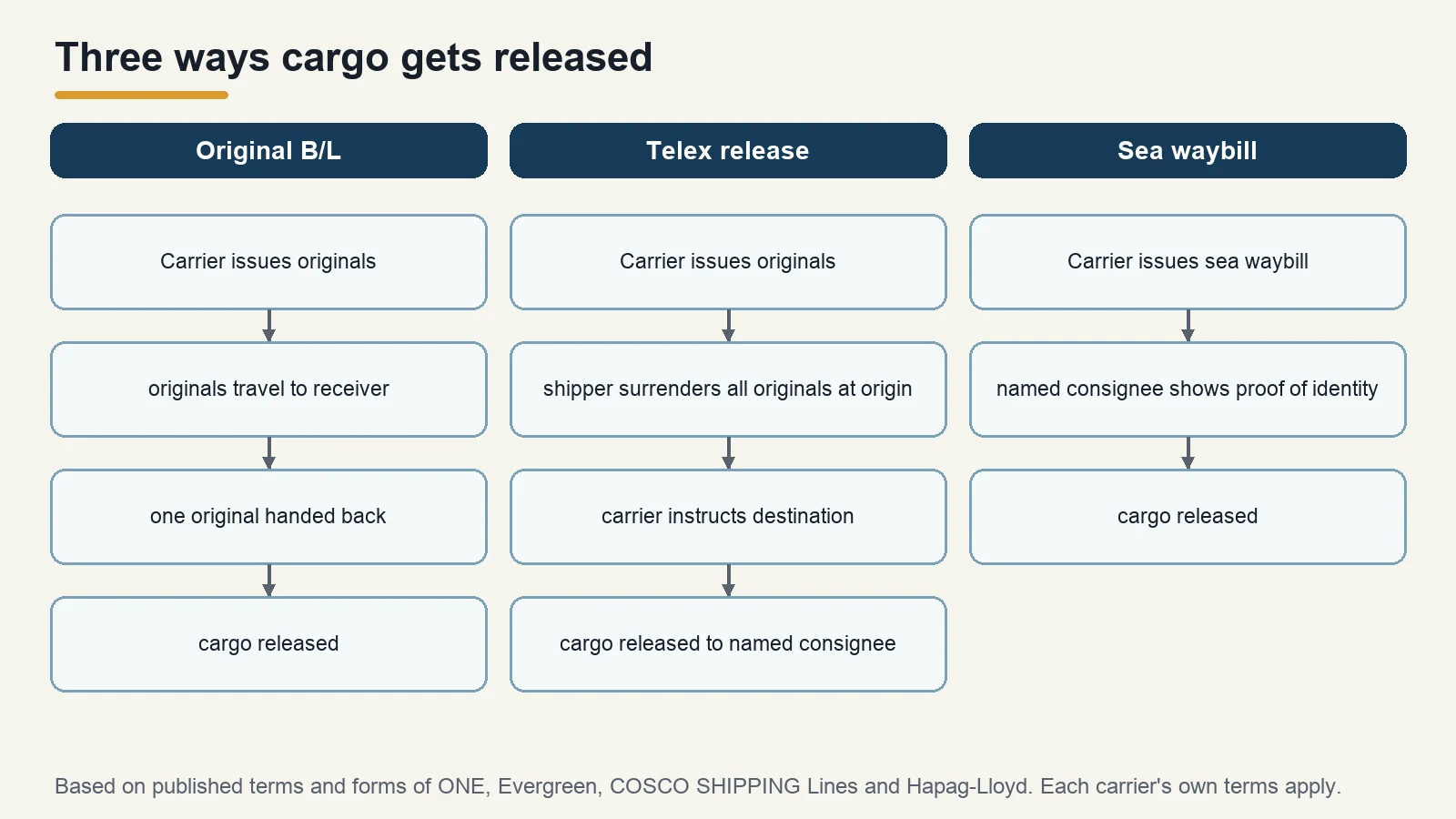
With an original B/L, the carrier issues paper originals, and the cargo is released at destination when an original is handed back.
ONE's bill of lading terms set this out for a negotiable ("to order") bill: "one original Bill of Lading, duly endorsed must be surrendered by the Merchant to the Carrier (together with any outstanding Freight) in exchange for the Goods or a Delivery Order." Evergreen's clauses describe the holder of a bill of lading as the person "to whom the property in the Goods has passed on or by reason of the consignment of the Goods or the endorsement of this Bill or otherwise." ONE's terms add that the carrier "has signed the number of Bills of Lading stated at the top," and "whenever one original Bill of Lading has been surrendered all other Bills of Lading shall be void."
In practice that means:
- The originals have to travel physically from you to the person collecting the goods, by courier or through the banks.
- The number of originals issued is printed on the bill.
- Once one original has been used to take delivery, the rest are void.
Where the risk sits: the originals are valuable. Whoever holds a properly endorsed original can take the goods, and if the originals arrive late, the cargo waits at the port.
2. Telex release (surrendered B/L)
"Telex release" (the carriers' forms also talk about "surrendering" the B/L) starts with an original bill of lading. The difference is that the originals are handed back to the carrier at the origin, and the carrier then instructs its destination office to release the cargo without them.
The carriers' own request forms show how it works. COSCO SHIPPING Lines' telex release application has the shipper confirm "a telex release of the above mentioned shipment for which we surrender all sets of original B/L." Hapag-Lloyd's telex release form asks the carrier to "release the above shipment to the consignee without presentation of the Original Bill of Lading."
The same forms show what the shipper takes on:
- It's hard to undo. COSCO's form says: "Once the carrier performs the Telex Release operation in the system, the goods will be delivered to the above named consignee upon arrival at the place of delivery. If there is any subsequent request to cancel the operation of the Telex Release, the carrier does not guarantee that it can perform according to the requirements."
- The shipper carries the risk. The same form says the delivery to the named consignee "shall be deemed that the carrier has fulfilled the obligation of correct delivery, and any responsibility, risk and expense arising therefrom shall be borne by the applicant."
- An indemnity is part of the request. Both forms include the shipper's promise to indemnify the carrier for delivering without the originals.
- A named receiver is needed. Hapag-Lloyd's form notes: "'To order' is not acceptable, please state Cargo Receiver."
- There are charges. Hapag-Lloyd's form says: "We will pay to Hapag-Lloyd all incurred charges."
Where the risk sits: once you've surrendered the originals and the release is done, you no longer hold the document that controls the goods. The cargo goes to the named consignee.
3. Sea waybill
A sea waybill is a different kind of document from the start. It's not a document of title. Evergreen's clauses state: "if it is issued as a Sea Waybill, it will not be a document of title to the Goods."
The goods are released to the consignee named on the waybill, who doesn't need to present an original. ONE's terms say that for a sea waybill, the carrier delivers "to the named consignee," "on production of such reasonable proof of identify [sic] as may be required by the Carrier."
Where the risk sits: there's no original to hold back. The named consignee can collect the goods when they arrive, so the document gives the shipper no control at the destination.
Side by side
| Original B/L | Telex release | Sea waybill | |
|---|---|---|---|
| Paper originals issued? | Yes | Yes, then surrendered at origin | No originals to present |
| What releases the cargo at destination | An original, handed back (endorsed if "to order") | The carrier's instruction after surrender | Named consignee's proof of identity |
| Passed on by endorsement? | Yes, when issued "to order" | No: the originals are surrendered | No: Evergreen says it "will not be a document of title" |
| Originals need to travel? | Yes | No | No |
| Control at destination stays with... | Whoever holds the original | The named consignee, once released | The named consignee |
A note on electronic bills of lading
Some carriers also issue electronic bills of lading (eBLs), which aim to keep the control of an original without paper. The International Chamber of Commerce reported in October 2026 that, in the FIT Alliance's 2026 survey, "eBL adoption reached 51.1%, up from 49.2% in 2024 and 33.0% in 2022." Whether you can use one depends on your carrier, your buyer and your bank.
Before you agree to an option
Each carrier has its own terms, forms and charges. Before you agree to a release method:
- Read the carrier's terms for your shipment, including any telex release form you'll be asked to sign.
- Check your sales contract and payment terms. The release method should fit what you and your buyer have agreed.
- Ask your bank if payment involves a letter of credit or documentary collection. The documents the bank needs must match what the carrier issues.
- Ask your freight forwarder to explain the carrier's local procedure.
The bill of lading also has to match your other shipping documents. The commodity codes on your paperwork are covered in our guide to HS codes for motorcycle tires and inner tubes. If you're still working out what fits in the container, see container internal dimensions vs door openings and our loading plan tool.
FAQ
What is a telex release?
The shipper hands the original bills of lading back to the carrier at the port of loading, and the carrier releases the cargo at destination without the originals. COSCO's request form describes it as a telex release "for which we surrender all sets of original B/L."
What's the difference between a sea waybill and a bill of lading?
A sea waybill is not a document of title, and the named consignee collects the goods with proof of identity. An original bill of lading is surrendered to the carrier to take delivery.
Can a telex release be cancelled?
Not reliably. COSCO's telex release form says that if there's a later request to cancel, "the carrier does not guarantee that it can perform according to the requirements."
What does "surrender B/L" mean?
It means the original bills of lading have been handed back to the carrier, usually at origin, so the cargo can be released at destination without them.
Which option should I choose?
That depends on your contract, your payment terms and your bank, so we don't recommend one. Check with your bank and freight forwarder before you decide.
Sources
| Source | URL | Checked |
|---|---|---|
| ONE (Ocean Network Express), Bill of Lading Terms | https://www.one-line.com/en/terms-and-rules/bill-of-lading-terms | 20261101 |
| Evergreen Line, Bill of Lading Clauses | https://www.evergreen-line.com/blclauses/jsp/BillOfLadingClauses.jsp | 20261101 |
| COSCO SHIPPING Lines (UK), Letter of Application for Telex Release (PDF) | https://world.lines.coscoshipping.com/lines_resource/local/england/defaultContentAttachment/20250919/Telex%20Release%20Request%20-full%20set%20of%20original%20BLs%20returned.pdf | 20261101 |
| Hapag-Lloyd, Letter of Indemnity (Telex Release Request) (PDF) | https://www.hapag-lloyd.com/content/dam/website/downloads/local_info/Letter_of_Indemnity-Telex_Release%E7%94%B5%E6%94%BE%E4%BF%9D%E5%87%BD.pdf | 20261101 |
| ICC, Electronic Bill of Lading adoption grows as focus shifts to interoperability (21 October 2026) | https://iccwbo.org/news-publications/news/electronic-bill-of-lading-adoption-grows-as-focus-shifts-to-interoperability/ | 20261101 |