Every bundle of tires and every carton of inner tubes in a container needs a mark that ties it to the right order, the right buyer and the right paperwork. When marks are missing, unclear or different from the documents, cargo gets held while someone works out what it is.
This guide explains what goes on a shipping mark, what to keep separate, how handling symbols fit in, and where your contract decides. Paragraph numbers refer to the UN and ISO texts, so you can check the originals.
What shipping marks are for
The UN's Recommendation No. 15, Simpler Shipping Marks, puts the purpose plainly. Shipping marks are there "to identify cargo and help in moving it rapidly, smoothly and safely without delays or confusion to its final destination and to enable the checking of cargo against documents" (paragraph 1).
The same paragraph describes what goes wrong: marks can become "so lengthy and detailed that the sides of packages can no longer hold them." The recommendation's answer is a short standard mark, with everything else kept separate.
It also notes that shipping marks "are predominantly stipulated by importers" (paragraph 5), so your buyer often tells you what to print.
The three kinds of marks on a package
The examples at the end of Recommendation No. 15 show three separate groups on one package:
- The standard shipping mark, which identifies the consignment and is copied onto the documents.
- Information marks, such as gross weight or product name, shown on the package but not part of the mark.
- Cargo handling marks, the symbols for handling instructions. The recommendation says to "adopt ISO Standards for cargo handling instructions." That's ISO 780.
Keep the three apart.
The standard shipping mark: four lines
Paragraph 10 says the standard shipping mark "is made up of the following four elements in the sequence indicated" and should appear on both packages and documents:
- Initials or abbreviated name of the consignee or buyer. The full name and address shouldn't be shown, except where rail (and conventionally road) transport requires it. The recommendation suggests exporter and importer "agree on a set of initials/abbreviations to be used for all shipments between them."
- Reference number. One number, "as brief as possible", for example the shipment, order or invoice number the seller and buyer agree on. Words like "Order No." and dates next to the number "should be avoided."
- Destination. The port or place of ultimate destination "should always be shown". With transshipment, you can add the transshipment point after VIA, but in multimodal transport, show only the final destination.
- Package number. The running number and, where known, the total: "1/25", "2/25" and so on to "25/25".
Any element that isn't needed for a shipment can be left out.
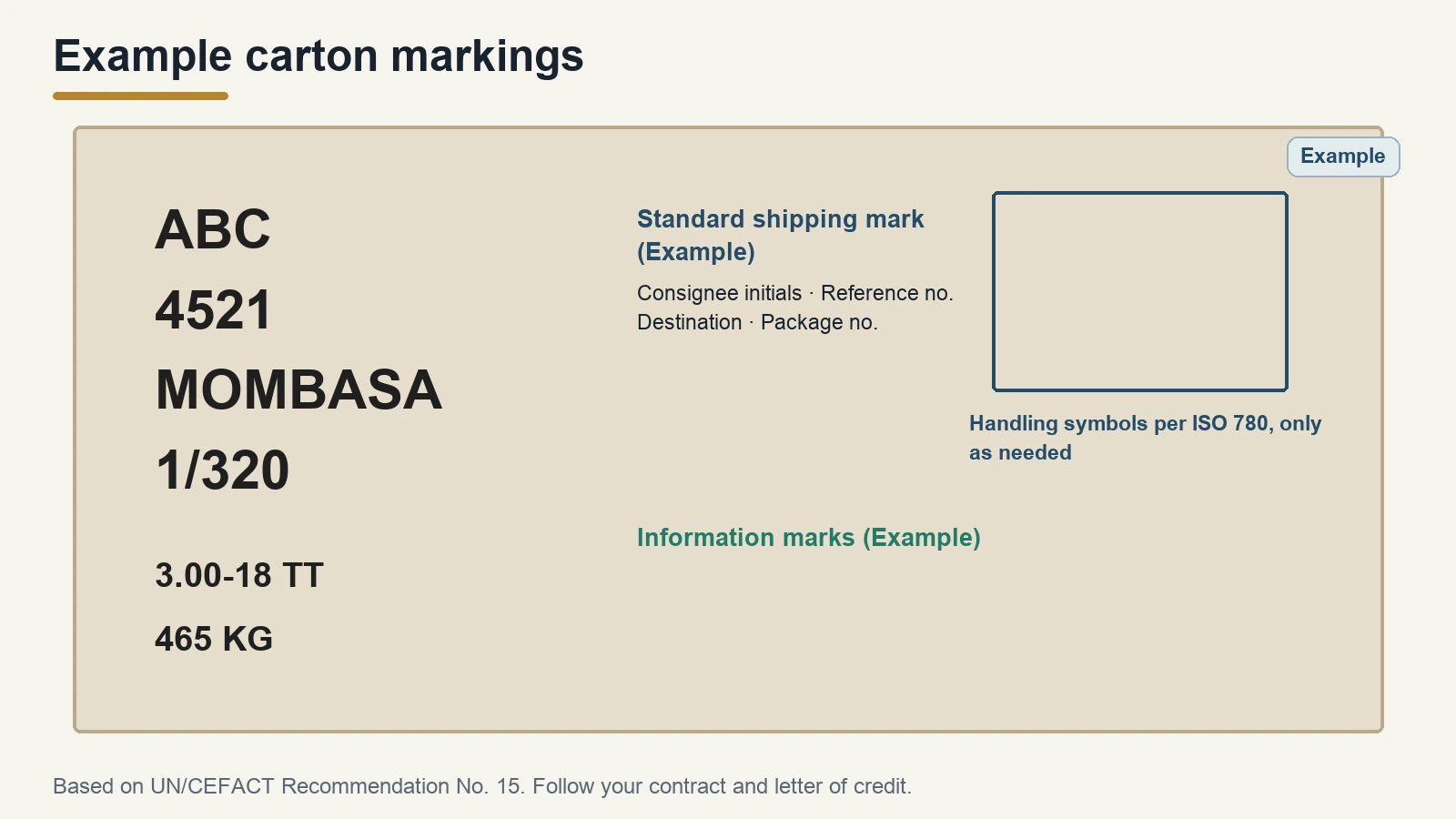
Here's an example of a standard shipping mark for a tire shipment. Every value is made up:
ABC
4521
MOMBASA
1/320
In this example, ABC is the buyer's agreed initials, 4521 the order number, Mombasa the destination and 1/320 the first of 320 bundles.
Limits on length and characters
Paragraph 15.1 says shipping marks "must not exceed ten lines of 17 characters per line."
The recommendation also limits the characters (paragraph 15.2) to the letters A to Z, the numerals 0 to 9, the space, and full stop, hyphen, parentheses, slash and comma. It asks you to avoid plus, colon, apostrophe, equals sign, question mark and asterisk. It also says:
- Don't use diamonds, triangles, squares or other figures in the mark.
- If the mark is needed in another alphabet, show at least one version in the Roman alphabet. Only that version goes on the documents.
- Avoid colour coding such as green stripes or crosses.
Information marks: useful, but separate
Information marks "are not essential for the delivery to destination", but they "are often important for identification, safety and handling purposes" (paragraph 11). The recommendation says to show them "clearly separated from the shipping mark." For tires, the useful ones are:
- Product name. Paragraph 12 calls it "useful to prevent mistaken identity of those products which, visually, are not readily identifiable." Tire and tube sizes that look alike are a good example. Writing the size, and TT or TL where it matters, on each bundle or carton helps at both ends. Our TT vs TL guide explains the difference.
- Gross weight in kilograms. Mark it "whenever it assists safe handling", below the shipping mark but separated from it, for example "462KG" (paragraph 13). Labels like "GROSS/BRUTTO WEIGHT" aren't needed. This is the weight of the package. The container's weight for the ship is a separate figure, explained in our guide to VGM.
- Country of origin, import licence number and similar details. These are "sometimes required by government regulations" (paragraph 14). If they're required, keep them separate from the shipping mark, as short as possible, and to "an absolute minimum."
Paragraph 15 adds that net weight and dimensions are "normally not necessary" on packages.
Where and how to mark the package
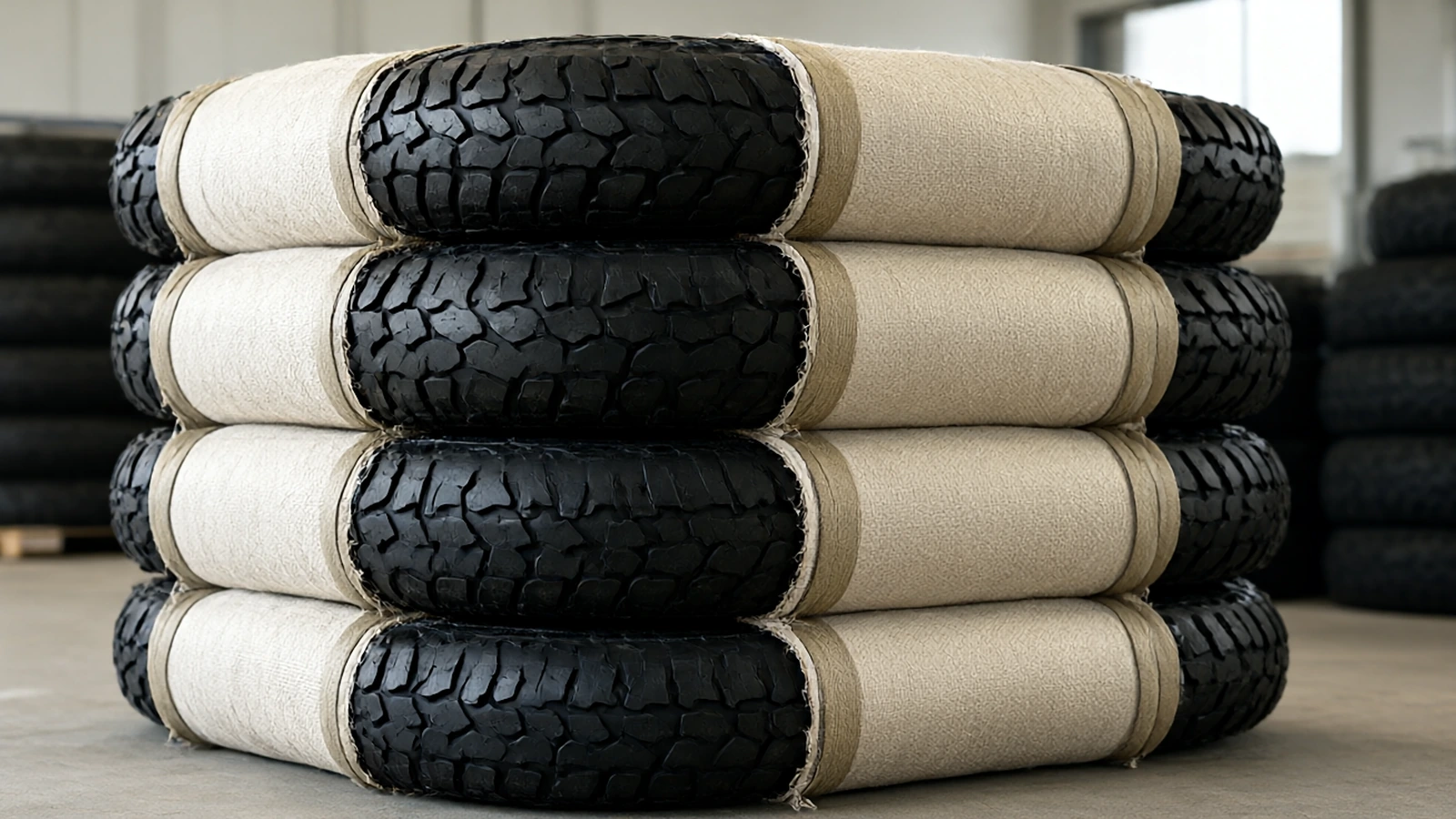
Illustration, not a photo of our warehouse.
Paragraph 26 sums up cargo marking as "Big, Bold and Brief". The standard shipping mark:
- "should be marked centrally on two sides of the package or pallet load"; loose cargo by conventional sea freight should be marked on the top too;
- should be "in characters 5 cm high", though this "can be varied where necessary in proportion to the size of the package";
- should preferably be stencilled in black ink, or a colour that contrasts with the background, which is "waterproof, permanent and resistant to humidity and friction."
The recommendation's notes add that red "should only be used for dangerous cargo", and that information marks should be in smaller characters or a different colour.
Paragraph 27 has notes for specific package types. Several apply to tire cargo:
- "Bags and sacks should be marked on both sides with a marking fluid which impregnates the material." If your bundles are wrapped in woven bags, this is the closest match.
- "Areas which will be covered by straps or bands should not be marked." Plan where the straps go on a bundle before you stencil it.
- "Old marks should be completely obliterated." This matters when cartons are reused.
Agree the bundle and strap positions first, then apply the four-line standard shipping mark described above.
Handling symbols: ISO 780
ISO 780:2015 "specifies a set of graphical symbols conventionally used for marking of distribution packages" to convey handling instructions. It applies to packages containing any kind of goods, but doesn't cover handling of dangerous goods. The standard has 17 symbols. It says they "should be used only when necessary", and that a package "shall have a minimum number of types of graphical symbols as needed."
The parts of the standard that are publicly readable set out these general rules:
- Colour (3.3): symbols shall be black. If black wouldn't show clearly on the package, add a contrasting panel, preferably white. Avoid red, orange and yellow, "which could result in confusion with the labelling of dangerous goods."
- Size (3.4): "For normal purposes the overall height of the graphical symbols shall be 100mm, 150mm or 200mm", though they can be larger or smaller for the package as long as they stay visible.
- Display (3.2): on large packages, symbols should preferably be stencilled directly on the package, or may appear on a label.
The full meaning, placement and number of each symbol are in the standard's tables, which are only in the paid edition. We haven't listed or drawn them here. If your buyer asks for particular symbols, work from the full standard or from the buyer's own instructions.
Full container loads: when less is enough
Paragraph 16 says the standard mark can be simplified for full loads sent from one shipper to one consignee:
- If one set of documents covers the load and the packaging and contents are "identical in every way" (size, type, grade), the standard shipping mark "should not be at all necessary."
- If more than one set of documents covers the load, or the packages' contents differ, only the reference number and package number "should be necessary."
A container of mixed tire sizes falls under the second case. Either way, paragraph 17 says "it must be possible to cross-reference packages to a comprehensive packing list."
Your contract and letter of credit decide
Recommendation No. 15 is a recommendation, and it's addressed largely to importers. What you actually print is whatever your contract and letter of credit say. If the buyer specifies marks, follow their wording exactly, line by line.
On documents, the mark goes in the "Marks and Numbers" box of the UN Layout Key (paragraph 25). The recommendation asks buyers not to call for extra details there, but if a letter of credit does, the bank checks documents against the credit. Invoice and packing list marks need to match the credit and the packages.
A quick checklist
- Agree the mark with the buyer before production: initials, reference number, destination, package numbering.
- Check it against the contract and letter of credit, character for character.
- Keep information marks, such as size, TT/TL and gross weight, separate from the shipping mark.
- Mark two sides of each bundle or carton, in waterproof black ink, clear of the straps.
- Use handling symbols only where needed, in black, following ISO 780.
- Number packages so they match the packing list, and copy the same mark into the documents.
FAQ
What is a shipping mark?
It's the short identifier on each package that links it to the shipment's documents. The UN's standard mark has four elements in this order: the consignee's initials, a reference number, the destination and the package number.
What's the difference between a main mark and a side mark?
Recommendation No. 15 doesn't use those terms. It separates the standard shipping mark from information marks. If a buyer asks for a "side mark", ask them exactly what it should contain and where it goes.
How big should the letters be?
The UN recommendation says the shipping mark's characters should be 5 cm high, varied in proportion to the package size where necessary. Your contract can specify something else.
Do I need to print "Made in China" on every carton?
Country of origin is an information mark that's sometimes required by government regulations. Whether you need it depends on the destination and your contract. If it's required, keep it separate from the shipping mark.
Can I use colour to mark different sizes?
The UN recommendation says colour coding "should be avoided whenever possible." ISO 780 asks for handling symbols in black and warns against red, orange and yellow. Printing the size as text is clearer.
Sources
| Source | URL | Checked |
|---|---|---|
| United Nations, UN/CEFACT Recommendation No. 15, Simpler Shipping Marks (final draft text, TRADE/CEFACT/1999/13, 8 January 1999; paragraphs cited in text) | https://digitallibrary.un.org/record/267007 | 20261106 |
| ISO 780:2015, Packaging — Distribution packaging — Graphical symbols for handling and storage of packages (public preview: scope, 3.2–3.5, foreword) | https://cdn.standards.iteh.ai/samples/59933/c2869e00e9fc44f798fa6d23b7390de2/ISO-780-2015.pdf | 20261106 |
| ISO, ISO 780:2015 catalogue page | https://www.iso.org/standard/59933.html | 20261106 |