What Is VGM? Container Weight Rules for Tire Shipments
When you book a container, the shipping line will ask for the VGM. It's a single number, the container's verified gross mass, but it comes with rules about how you get it, who signs it and when it has to arrive. If it's missing, the container doesn't go on the ship.
This guide explains what VGM means, the two ways the rules let you obtain it, and how the numbers add up for a typical tire and inner tube load. Paragraph numbers refer to the IMO guidelines so you can check the original.
Where the VGM rule comes from
The requirement sits in the SOLAS Convention (International Convention for the Safety of Life at Sea), chapter VI, regulation 2. The IMO says the amendment was accepted on 1 January 2016 and entered into force on 1 July 2016.
How to apply it is set out in the IMO's Guidelines regarding the verified gross mass of a container carrying cargo, circular MSC.1/Circ.1475. The guidelines give the reason in paragraph 1.1: the safety of the ship, of workers aboard ships and ashore, of the cargo and of overall safety at sea. The ship's stowage plan depends on knowing what each container really weighs.
What "verified gross mass" means
Two definitions matter:
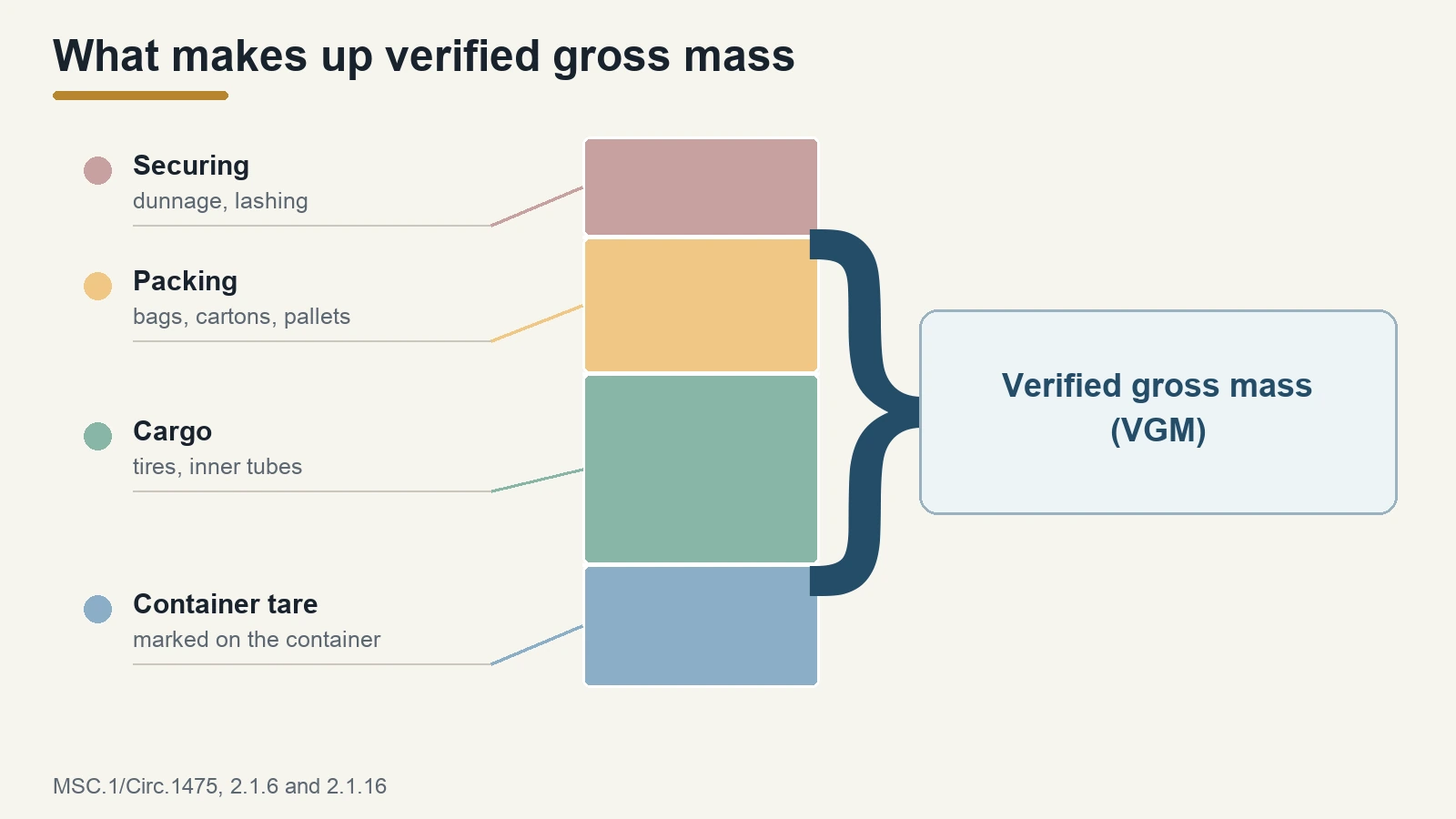
- Gross mass (2.1.6): the container's tare mass plus the masses of all packages and cargo items, "including pallets, dunnage and other packing material and securing materials packed into the container".
- Verified gross mass (2.1.16): the total gross mass of a packed container "as obtained by one of the methods described in paragraph 5.1".
So VGM is not just "the weight of my tires". It includes the empty container, every bag and carton, and anything used to block or brace the load. It also has to come from one of two specific methods, not from an estimate.
The tare mass (2.1.14) is the mass of the empty container. Paragraph 12.1 notes that the tare weight appears on the container under the ISO marking standard (ISO 6346).
Who is responsible
The guidelines are clear: "The responsibility for obtaining and documenting the verified gross mass of a packed container lies with the shipper" (4.1).
The shipper (2.1.12) is the party named as shipper on the bill of lading or sea waybill, or the party that concluded the contract of carriage with the shipping company. If a container is packed by several parties or holds cargo from several parties, the shipper is still responsible (5.1.3).
If a forwarder or factory packs the container for you, that doesn't move the responsibility. Under Method No.2, a third party that packed the container "should inform the shipper of the mass of the cargo items and packing and securing material" it packed (5.1.2).
The two methods
Paragraph 5.1 sets out the only two ways to get a VGM.
Method No.1: weigh the packed container
After the container is packed and sealed, the shipper weighs it, or arranges for a third party to weigh it (5.1.1).
If the container is weighed on a truck, the tare mass of the road vehicle (and tractor, where applicable) is subtracted, using the figures in their registration documents. The mass of fuel in the tractor's tank should also be subtracted (11.1). If two containers are on one vehicle, each must be weighed separately; dividing the total by two "should not be allowed" (11.2).
Method No.2: weigh the contents and add the tare
The shipper (or a third party by arrangement) weighs "all packages and cargo items, including the mass of pallets, dunnage and other packing and securing material", then adds the container's tare mass (5.1.2).
Two conditions apply:
- The weighing method is subject to certification and approval by the competent authority of the State where the container was packed and sealed (5.1.2.3). How that works is up to each State.
- Original sealed packages that have their accurate mass "clearly and permanently marked" on them don't need to be weighed again (5.1.2.1).
Under both methods, the scale, weighbridge or other device must meet the accuracy standards of the State where it is used (7.1).
Sending the VGM: document, signature, deadline
The document. The shipper communicates the VGM in a shipping document. It can be part of the shipping instructions or a separate declaration, and it should clearly state that the figure is the "verified gross mass" (6.1). It must be signed by a person authorized by the shipper; an electronic signature, or the person's name in capitals, is acceptable (6.2).
Who receives it. Because the contract of carriage is with the shipping company, the shipper can meet the obligation by sending the VGM to the shipping company (6.3.1).
The deadline. This is the part people most often ask about, and the guidelines don't give a fixed time. Paragraph 6.3.2 says: "There is no SOLAS prescribed time deadline for the shipper's submission of the verified gross mass other than such information is to be received in time to be used by the master and the terminal representative in the ship stowage plan." It is the shipping company's responsibility to tell the shipper the specific deadline.
So follow the cut-off in your shipping line's or terminal's notice for that sailing. Don't rely on a figure from another booking.
What happens when things go wrong
- No VGM. A packed container should not be loaded until its VGM has been obtained (4.2, 13.1). The master and the terminal may weigh it on the shipper's behalf; whether and how, and who pays, is for the commercial parties to agree (13.1).
- Late VGM. A container whose VGM isn't available in time for the stowage plan "will be denied loading" (15.2). Costs such as storage, demurrage or return are subject to the contracts between the parties (15.2).
- Different figures. A declared weight given before verification is replaced by the VGM (9.1). If the terminal weighs the container and gets a different VGM from yours, the terminal's figure is used (9.2).
- Overweight. A container may not be packed beyond the maximum gross mass on its CSC Safety Approval Plate, and one that exceeds it may not be loaded (10.1).
- The master's decision. Providing the VGM is a condition for loading, but it "does, however, not constitute an entitlement for loading". The master keeps the final say (14.1).
A worked example for a tire load
Example. All quantities and weights below are for illustration only. They are not the packing figures of any real shipment.
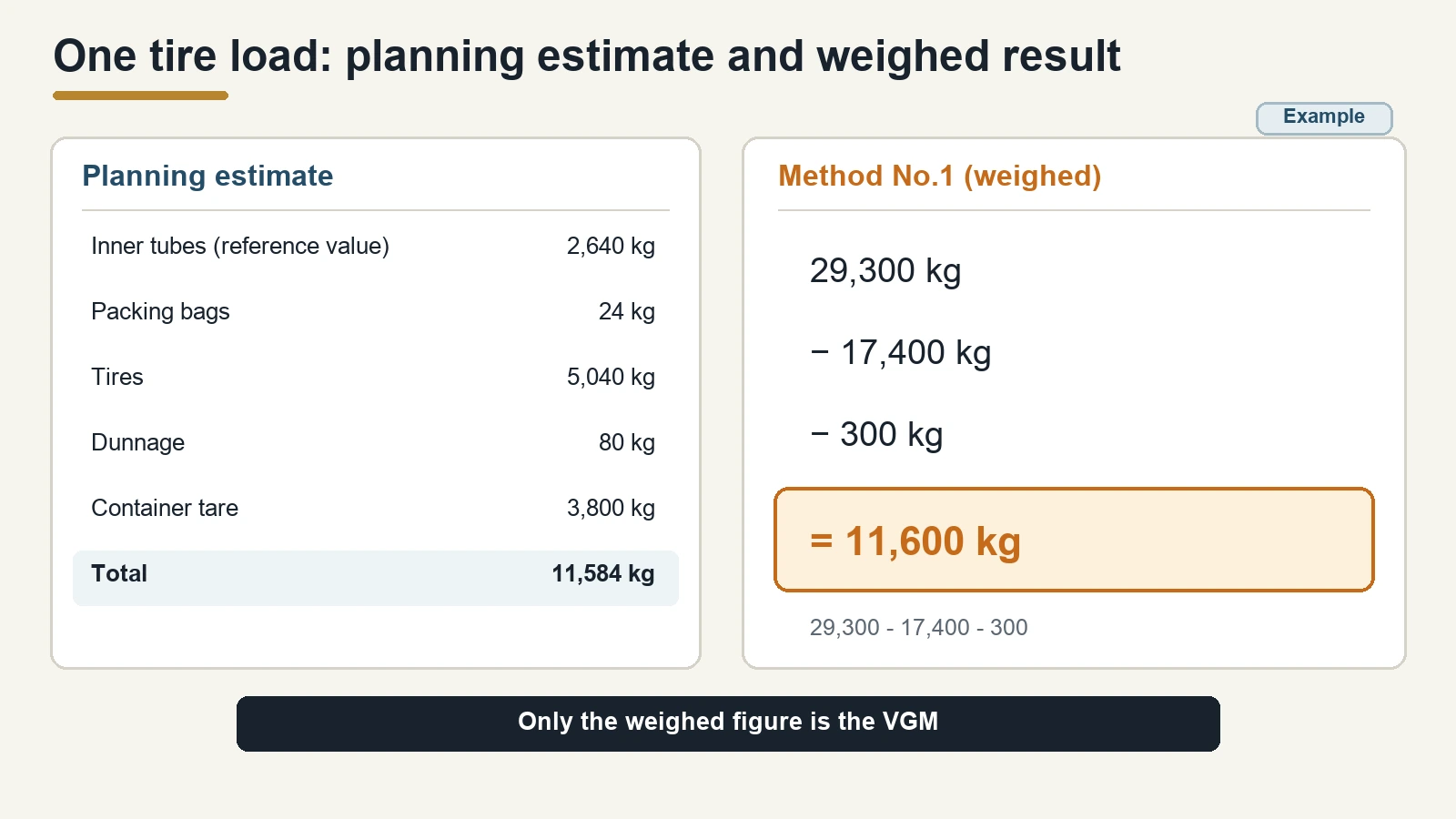
A shipper plans one container with motorcycle tires and butyl inner tubes. Before packing, they make a planning estimate:
| Item | Quantity | Weight each | Total |
|---|---|---|---|
| Inner tubes, butyl 3.00-18 | 6,000 | 0.44 kg (reference value) | 2,640 kg |
| Woven bags (50 tubes per bag) | 120 | 0.20 kg (example) | 24 kg |
| Motorcycle tires | 1,200 | 4.20 kg (example) | 5,040 kg |
| Dunnage and securing material | — | — | 80 kg (example) |
| Cargo subtotal | 7,784 kg | ||
| Container tare (as marked on the container) | 1 | 3,800 kg (example) | 3,800 kg |
| Estimated gross mass | 11,584 kg |
The 0.44 kg tube weight comes from the butyl inner tube table on our reference page. It's a reference value; the actual weighed figure is what counts. Tube weight varies with size, material and factory, so use the reference value only to plan.
This estimate is not a VGM. Neither method allows a VGM based on reference weights. To get the VGM, the shipper uses one of the two methods:
- Method No.1 (Example): the packed, sealed container is weighed on a truck at a weighbridge. Reading 29,300 kg, minus the registered tare of tractor and trailer 17,400 kg, minus fuel 300 kg = 11,600 kg VGM.
- Method No.2: every bag of tubes, every tire lot, and the packing and securing material are weighed with a method certified in the country of packing, and the container's tare is added.
In this example the weighed VGM is 16 kg more than the estimate. That's the point of verification: the planning figure was close, but only the weighed figure goes on the VGM declaration.
A short checklist
- Agree early who packs the container and who will report the cargo and packing weights (5.1.2).
- Choose Method No.1 or No.2. For Method No.2, check that the weighing method is certified where the container is packed (5.1.2.3).
- Read the tare from the container itself (12.1) and check the maximum gross mass on the CSC plate (10.1).
- Put the VGM in a signed document that clearly says "verified gross mass" (6.1, 6.2).
- Send it before the cut-off your shipping line or terminal gives you (6.3.2).
For how to stow and secure the load itself, see our guide to container stuffing and the CTU Code. To work out volume before you weigh anything, use the loading plan calculator and the inner tube calculator.
FAQ
What does VGM stand for in shipping?
Verified gross mass: the total gross mass of a packed container, including its tare and all packing and securing material, obtained by one of the two methods in paragraph 5.1 of IMO MSC.1/Circ.1475.
Who is responsible for the VGM?
The shipper named on the bill of lading or sea waybill, or the party that made the contract of carriage (4.1, 2.1.12). That stays true if someone else packs the container.
How do I calculate VGM?
Either weigh the packed and sealed container (Method No.1), or weigh all cargo, packing and securing material with a certified method and add the container's tare (Method No.2). Estimates and reference weights don't count as a VGM.
What is the VGM deadline?
SOLAS doesn't set one. The VGM has to arrive in time for the ship stowage plan, and the shipping company tells the shipper the specific deadline (6.3.2). Follow your carrier's or terminal's notice.
What if the terminal's weight differs from mine?
If the port terminal weighs the container and gets a different VGM, the terminal's figure is used (9.2).
Sources
| Source | URL | Checked |
|---|---|---|
| IMO, MSC.1/Circ.1475, Guidelines regarding the verified gross mass of a container carrying cargo, 9 June 2014 (paragraphs cited in text) | https://wwwcdn.imo.org/localresources/en/OurWork/Safety/Documents/MSC.1%20Circ.1475.pdf | 20261104 |
| IMO, Verification of the gross mass of a packed container (entry into force 1 July 2016) | https://www.imo.org/en/OurWork/Safety/Pages/Verification-of-the-gross-mass.aspx | 20261104 |
| tirecbm.com reference data, butyl inner tube 3.00-18 = 0.44 kg (reference value) | https://tirecbm.com/reference/ | 20261104 |
| Worked example: our calculation (Python, 4 November 2026); all other weights are examples | — | 20261104 |