Container Stuffing Basics for Tire Cargo: What the CTU Code Says
A loading calculator tells you whether your tire bundles fit in a container. It doesn't tell you how to stack them, where the weight should sit, or what stops them shifting at sea. Those decide whether the cargo arrives intact and the container is safe to lift, drive and open.
The international reference for this is the CTU Code: the IMO/ILO/UNECE Code of Practice for Packing of Cargo Transport Units. This guide goes through the parts of it that matter most when you're stuffing a container with tires, with the clause numbers so you can check the original.
What the CTU Code is
The CTU Code was developed jointly by the International Maritime Organization (IMO), the International Labour Organization (ILO) and the United Nations Economic Commission for Europe (UNECE), and published by the IMO in 2014 as circular MSC.1/Circ.1497. "Cargo transport units" include freight containers, road vehicles and rail wagons.
The IMO describes it as "a non-mandatory global code of practice". It doesn't replace national rules or your carrier's requirements. Its key points are written as plain do's and don'ts, which makes it a practical checklist.
The Code has no section specifically about tires. Its general guidance applies to tire cargo like any other; where we connect a clause to tire shipments, we say so.
Who is responsible for what
The Code calls the person or company that loads the container the packer. Under paragraph 4.2.3, the packer is responsible for, among other things:
- checking the container is in a suitable condition before packing;
- making sure the floor isn't overstressed during packing;
- making sure "the cargo is correctly distributed in the CTU and properly supported where necessary";
- making sure the container isn't overloaded;
- making sure the cargo is sufficiently secured;
- closing and sealing the container and reporting the seal details to the shipper;
- accurately determining the gross mass of the packed container and passing it on.
If a factory or forwarder does the stuffing, these are the points to ask them about.
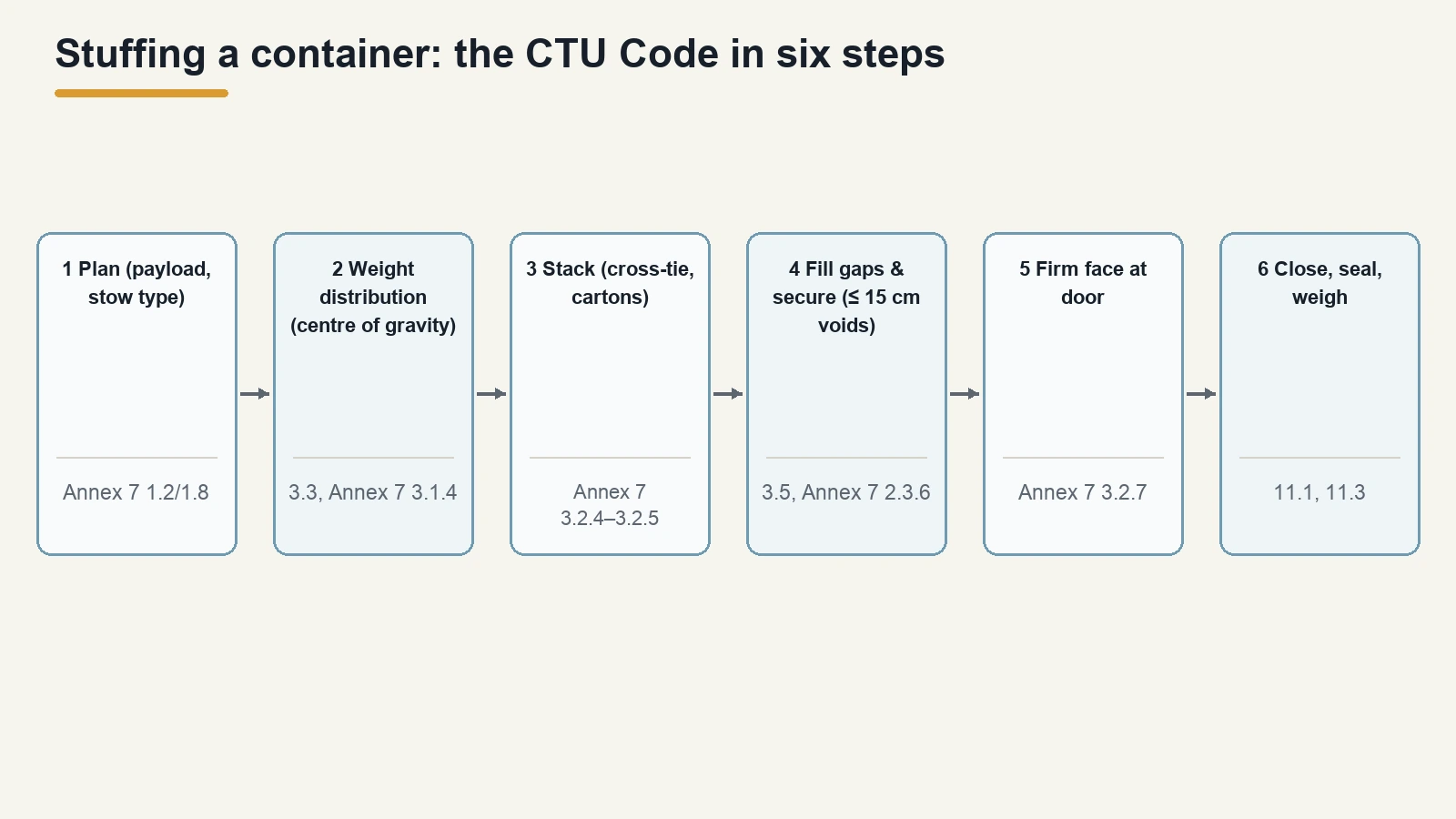
Step 1: Plan before you load
Annex 7, section 1 of the Code deals with planning. Three points matter most for tire cargo.
Choose a tight stow or a secured stow. The Code says planning should aim at either "a tight stow, where all cargo packages are placed tightly within the boundaries of the side and front walls", or "a secured stow, where packages do not fill the entire space and will therefore be secured within the boundaries of the CTU by blocking and/or lashing" (Annex 7, 1.2). If your bundles fill the container wall to wall, you're planning a tight stow; if they don't, the load has to be secured.
Check the weight limits, not just the volume. "The mass of the planned cargo should not exceed the maximum payload of the CTU" (Annex 7, 1.8). For freight containers, the permitted maximum gross mass is on the CSC safety approval plate. The Code also warns that limits along the route, from roads, lifting equipment and so on, "may be considerably lower than the permitted gross mass" (1.9).
Respect package markings and stacking strength. Packages marked "this way up" should be packed that way, and a marked maximum stacking height "should not be exceeded" (1.5). Where packages are stacked, each one "should be capable of supporting those placed above them" (1.6). It's worth checking wherever cartons, such as inner tubes, would sit under heavier bundles.
Our container loading plan tool works out the volume your bundles or cartons take up and how much of a container they fill. Use it for the space question, then use the points in this guide for the weight and stowage questions.
Step 2: Get the weight distribution right
The key requirements in chapter 3 of the Code include:
- "Do distribute heavy cargo appropriately over the floor area."
- "Do load with the centre of gravity correctly located in the CTU."
- "Do not load with eccentric load distribution."
- "Do not stow heavy goods on top of light goods."
(CTU Code, 3.3)
Where the centre of gravity should be
Annex 7, 1.11 sets out the three directions:
- Lengthwise: within allowed limits.
- Across: close to the half width of the container.
- Height: below half the height of the cargo space.
For containers that are lifted level, Annex 7, 3.1.4 adds that the cargo's centre of gravity should be close to the middle of the container's length and width. "The eccentricity of the centre of gravity of the cargo should not exceed 5% in general. As a rule of thumb this can be taken as 60% of the cargo's total mass in 50% of the freight container's length." The Code says up to 10% "could be accepted" under particular circumstances, because some container spreaders can adjust for it.
Working it out: an example
The Code gives a formula for the lengthwise centre of gravity (Annex 7, appendix 4, section 3): multiply the mass of each part of the load by the distance of its centre from the front, add those up, and divide by the total mass.
d = Σ(mass × distance) ÷ Σ mass
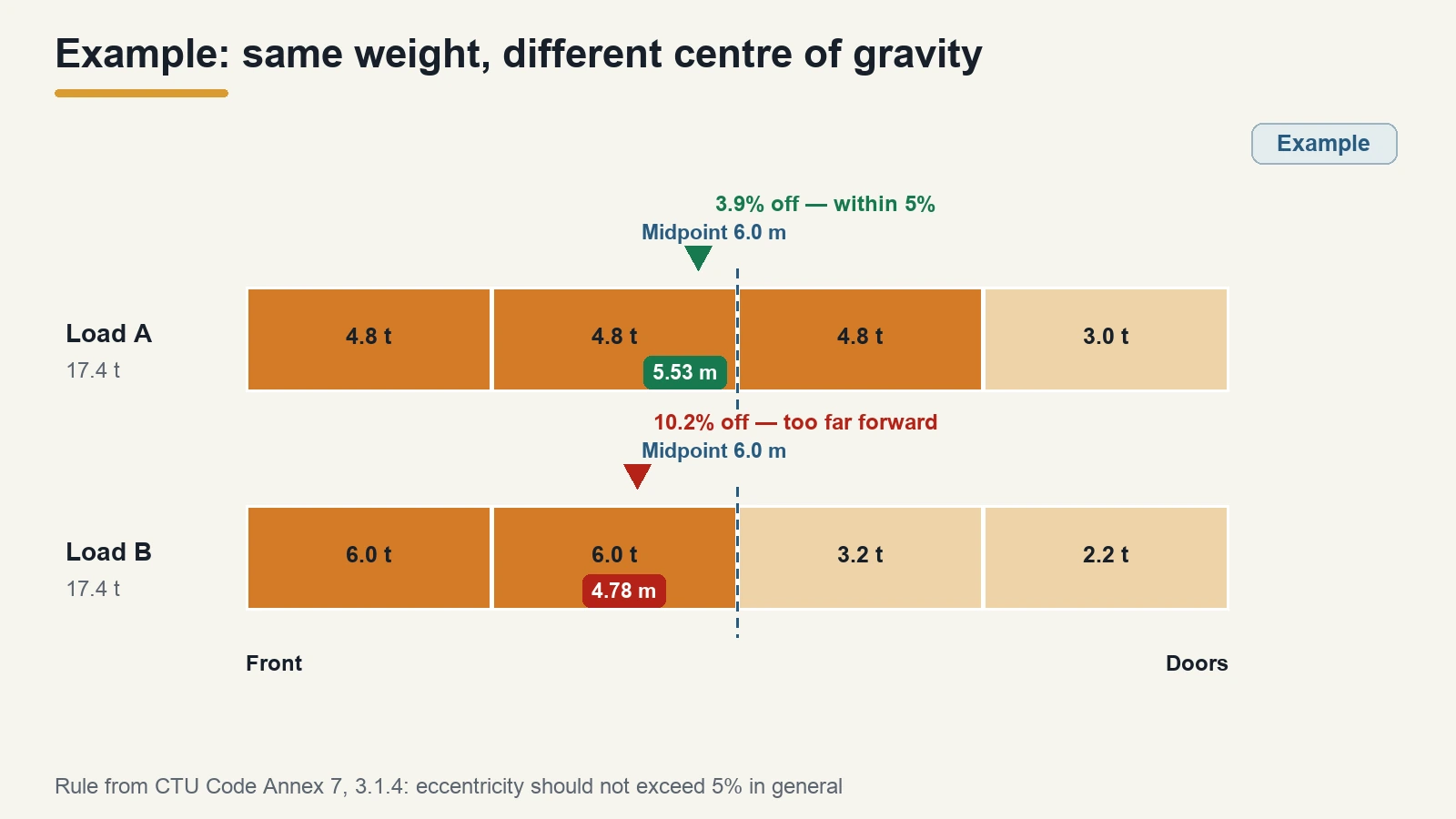
Example only. Say a stowage area 12.0 m long is loaded in four 3-metre sections. The section centres are 1.5, 4.5, 7.5 and 10.5 m from the front.
| Section 1 | Section 2 | Section 3 | Section 4 | Total | |
|---|---|---|---|---|---|
| Load A: mass (t) | 4.8 | 4.8 | 4.8 | 3.0 | 17.4 |
| Load B: mass (t) | 6.0 | 6.0 | 3.2 | 2.2 | 17.4 |
- Load A: (4.8 × 1.5 + 4.8 × 4.5 + 4.8 × 7.5 + 3.0 × 10.5) ÷ 17.4 = 96.3 ÷ 17.4 = 5.53 m from the front. The middle is 6.0 m, so it's 0.47 m off, which is 3.9% of the length. The front half carries 55.2% of the weight. That's inside the 5% general limit and the 60/50 rule of thumb.
- Load B: the same total weight, but the heavy bundles are all in the front half. 83.1 ÷ 17.4 = 4.78 m, 1.22 m off the middle, or 10.2% of the length. The front half carries 69% of the weight. That's beyond both the 5% general limit and the 10% the Code allows only in particular circumstances.
Load B is what happens when the heaviest sizes go in first and light cartons fill the rest.
Step 3: Stack the tires so the load holds its shape
The CTU Code describes stacking by package type. Tire bundles wrapped in woven bags aren't named in the Code. The closest description is "packages with a less defined shape like bags or bales", which "may be stacked in an interlocking pattern, also called cross-tie, thereby creating a solid pile that may be secured by blocking or fencing" (Annex 7, 3.2.5). That's our reading of how the clause fits bundles, not something the Code says about tires.
For cartons, such as inner tubes, the Code says stacking "should be precise in a way that the mass from above is transferred to the vertical boards of the cartons below", with sheets of fibreboard, plywood or pallets between layers if needed (3.2.4).
General rules from the key requirements also apply: avoid "irregular layers of packages if it can be avoided", and don't stow heavy goods on top of light goods (3.3). Our guide to tire bundle packaging types explains the common bundle sizes.
Step 4: Deal with gaps and secure the load
Gaps give cargo room to shift. Among the key requirements for securing (3.5):
- "Do fill void spaces when necessary."
- "Do use blocking or lashing or a combination of these methods to prevent the cargo from sliding and tipping in any direction."
- "Do not secure the cargo with devices overstressing the structure of the CTU or the cargo."
Annex 7, 2.3.6 is specific about gaps in a tight stow. Void spaces "should be filled", and can be filled with empty pallets inserted vertically and tightened with timber battens. Material "which may deform or shrink permanently, like rags of gunny cloth or solid foam of limited strength, should not be used for this purpose". Small gaps needed for packing and unpacking are acceptable, but "the sum of void spaces in any horizontal direction should not exceed 15 cm."
Blocking and lashing methods and calculations are in annex 7, section 4 and its appendices.
Step 5: Finish with a firm face at the door
The last row matters most for whoever opens the container. The Code says that near completion of packing, "care should be taken to build a firm face of the cargo so as to prevent a 'fall out' when the CTU is opened" (Annex 7, 3.2.7). If you're unsure the face is stable, it suggests strapping the top layers back to securing points or building a timber fence between the rear posts.
It also points out why: "a freight container on a trailer usually inclines towards the doors aft and that cargo may move against the doors due to vibration induced shift or by jolts during transport." Planning should also consider the people who unpack, and "the possibility of cargo falling out when the CTU is opened should definitely be avoided" (1.7).
Step 6: Close, seal and weigh
Chapter 11 covers what happens after the last bundle goes in:
- Close it properly. The packer "should ensure that all closures are properly engaged and secured" (11.1.1).
- Seal it. When required, containers in international transport should "be sealed immediately upon completion of the packing with a seal bearing a unique identification number", and "countries may require that such seals meet the standard of ISO 17712" (11.1.2).
- Determine the gross mass. "The packer is responsible for accurately determining the gross mass of the packed CTU" (11.3.2), and should tell the shipper the container number, the verified gross mass and the seal number so they appear on documents such as bills of lading (11.3.3).
Those numbers end up on your shipping documents, which our guide to original bills of lading, telex release and sea waybills explains. For container sizes, see container internal dimensions and door openings.
FAQ
What is the CTU Code?
The IMO/ILO/UNECE Code of Practice for Packing of Cargo Transport Units, published by the IMO in 2014 as MSC.1/Circ.1497. It gives guidance on packing containers and other cargo transport units safely. The IMO describes it as non-mandatory.
How should weight be distributed in a container?
Spread heavy cargo over the floor and keep the centre of gravity close to the middle of the length and width, and below half the height of the cargo space. The Code says the eccentricity should not exceed 5% in general; as a rule of thumb, no more than 60% of the cargo's mass in half the container's length.
Does the CTU Code say how to stack tires?
No. It has no section specifically about tires. Its general rules on stacking, weight distribution, void filling and securing apply to tire cargo like any other.
Sources
| Source | URL | Checked |
|---|---|---|
| IMO, MSC.1/Circ.1497, IMO/ILO/UNECE Code of Practice for Packing of Cargo Transport Units (CTU Code), 16 December 2014 (chapters 3, 4, 11; annex 7) | https://wwwcdn.imo.org/localresources/en/OurWork/Safety/Documents/1497.pdf | 20261102 |
| IMO, IMO/ILO/UNECE Code of Practice for Packing of Cargo Transport Units (CTU Code) (overview page, "non-mandatory") | https://www.imo.org/en/ourwork/safety/pages/ctu-code.aspx | 20261102 |
| Centre-of-gravity example: our calculation with the CTU Code formula (Python, 2 November 2026) | — | 20261102 |